Chapter 5
Life and Life's Purpose
We have looked at some aspects of living and being human that are required in order to really be able to understand life and its purpose:
-
An examined technical frame of reference for perceiving facts
(chapter 2);
-
Some misconceptions about life that prevent us from seeing ourselves and life as it is
(chapter 3);
-
A technical understanding of the forces of creation
(chapter 3);
-
A technical understanding of suggestion and conditioning; and the personality that was designed not to understand and experience and create, but rather to gain pleasure and escape pain
(chapter 4).
Now we can look at these same misconceptions about life (that we looked at in
chapter 3)
hopefully with new eyes: and see in the light of ideas that describe life as it is, without any known misconceptions.
We will look at these misconceptions one at a time; but no clear picture will develop until all of them have been reexamined.
After each misconception has been discussed, then we will look at the whole picture and perhaps see from a point of view that makes sense out of living and its purpose.
For ages, people have been crying to their Creator to answer their questions.
And, of course, He has.
The answers haven't always been to our liking.
But, let's look at one of them and see what we can see.
According to the story told in the Bible (one of the more recent accounts), the Creator says that it took Him six days to create a place where man could live.
And on the seventh day of the Creator's efforts, man was placed in what had been accomplished to that point.
Yet the universe and planet Earth have certainly been around more than six days longer than mankind has been here.
There are a lot of ways to try to resolve this contradiction:
-
The people who told the story got it wrong;
-
There is no Creator, and it's just a big joke;
-
The Creator has a very strange sense of humor and created things so they would look a lot older than they really are;
-
Or the story is true, and we don't understand it.
Let's assume for a moment that the story is more or less accurate.
What would a day be before there are planets to rotate around suns?
Why do we assume that the Creator's ``day'' has anything to do with our idea of a day?
Could it be that the Creator's ``day'' is what we would consider to be eons long?
That last seems to fit the facts as we know them, doesn't it?
And, if that is the case, then the seventh day hasn't ended yet, has it?
Most of us read this story in translation, because we don't speak or read the language it was written in.
Those who do will tell you a curious fact: it is clear in the original language that the creation is not yet finished -- just the point that is being made here.
When we start with the idea that the creation is not finished, it makes sense for the Creator to say that He is resting from His labors of eons; He may have other things that He intends to do, but He's going to actively work on them tomorrow (which none of us reading this will probably ever see while on Earth).
There's another interesting idea we can see from this story.
The Creator's idea of resting is sure different than ours.
When we rest, we usually sit around and do nothing.
His idea of resting is create man, then create a help mate for man, and make sure everything is going smoothly.
All this He says He did on the seventh day: His day of rest.
There's a lot more to that story, which is all in a very highly specialized technical language that was used by a group of wanderers thousands of years ago to talk about things that were not common experiences for the people of that time.
Things have changed today.
We have begun to study the world in which we live in a highly structured and technical manner.
We have words for things today that people thousands of years ago just didn't have.
So we can talk about all these ideas in a contemporary manner, without needing to make up new words or use existing words in odd ways.
We do need to agree on exactly what the words we are using mean, because most words have many definitions and we need to narrow it down to one.
We have been doing that throughout by giving the precise definition of the words we are using technically, as they are used.
So let's not attempt to explain an old story, but just put it into modern language so it's accessible to the understanding of each of us.
But, just as those wandering peoples had trouble finding words in a language that was mainly designed to talk about their daily living -- food and farming and hunting and herding and child raising and survival and pleasure seeking and personal interactions -- there are still a few ideas that we just don't have words for in contemporary English.
These ideas are still not part of our common experience, so we have never bothered to make up words for them.
Without experience, the words would have no meaning anyway.
So there are certain parts of this discussion that I just won't be able to make sense out of for the reader.
I can only allude to, or point the way to, an experience that each can find for themselves.
But I cannot discuss it, except with someone who has had the experience.
But most of these ideas about creation and creating can be discussed in language that we all can understand.
The physical necessities for life have more or less been created.
But we've just run into one of our language difficulties, because that statement is only partly true.
For now, we'll just talk about it as if it were completely true, while trying to remember that we don't have enough experience with the facts of creation and creating to understand what the idea refers to: partly created.
At any rate, the physical universe is here, planet Earth is here and has its energy source (primarily the sun), and there is an entire ecology on Earth and in the universe that can support life for mankind.
The creation, however, is still in progress, still evolving, to create something in the inner world, not just the outer.
Of course, that which is in the inner world always affects the outer world, so that statement is not really true, either.
It is still about the creation of the outer, physical, world.
But the continuing creation of the outer world will be accomplished to a large degree in the inner, spiritual, world; not just in the outer world.
So the Creator said He is not going to do it all for us any more: He's taking a little break and not working so hard.
At least some of the initiative, first force, must come from us; He won't do all the work today.
We have to start it.
He may well work with us, but we have to at least initiate it.
Now it is up to us to take our proper place in the scheme of things, and join Him in His work of creating.
The creation is not finished; it is still in a state of growth and development which we call evolution.
Each of us contains within us a part of the spirit of the Creator.
It is up to each of us to allow that small spark of Life to grow and develop, to evolve, so that we can continue the work of the Creator: with His assistance, of course.
And even this discussion is not quite right.
It is all considered from one point of view: ours.
What it might look like from the Creator's point of view is being more or less ignored.
Perhaps we will discuss that another day.
In the meantime, let's continue our look at creation as evolution.
That is one of the things that we have learned about Life, isn't it?
Life works by evolving.
A thing starts as something simple, the seed of something, or first force.
And through resistance, it changes or acquires a form and develops into something more complex, more evolved, more developed; or it grows.
If we can see that the creation is not finished yet, then man (who seems to be the highest form of life on planet Earth as far as we can tell) seems to have reached a point where the only way to go to continue this evolution is the inner, spiritual, world.
When we look at what we have done with the outer world, we see that we have subdued this planet.
I'm not saying that we have learned everything there is to learn.
That's not the point.
We have already made planet Earth a pretty safe place for human survival.
That was our first task, and it is done.
We have now gone way beyond that point.
We've ignored the rest of our job so much that we are concerned that we may soon remake the Earth into a place where human life can no longer survive.
We will discuss this more when we look at the last misconception, which is to see what humanity's further evolution might be.
Right now, it would just be good to see that we have reached somewhat of a dead-end.
We have learned enough to survive very well here, but not enough to be responsible.
Many of us are now convinced that we should be learning to be responsible with knowledge, still missing the point.
The creation is not over; our job up to now was simply to learn to survive on planet Earth, and then be about our task of assisting the Creator in completing the creation of planet Earth as a fit place for humanity to live, not just to survive.
By believing that the creation is finished, we have missed the place in our evolution where we could have said that the first part of the job was accomplished and started the next task.
By believing that the creation is finished, we did not see that humanity is still evolving and investigate that evolution on all the levels it is working on.
By not seeing humanity's complete evolution, we did not know what the stages were, so how could we tell whether a stage was done or not?
There have been a few who came along and tried to tell us, but we didn't pay much attention to most of them, then or now.
Imagine that we didn't know anything about a person's growth.
I am aware that we believe that this process is automatic; but anyone who has studied natural growth can tell you it is possible for a person to arrest their development at one of its stages and more or less stop it from continuing.
If our natural development from infant to grown-up were not automatic would we ever stop being babies, if no one had any experience with human growth?
How would we know when the stage of development called infancy was over, and it was time to start the next stage?
We would just grope around, doing the best we could.
But at a certain point, we would get the feeling that we should be doing something else, not relying on someone else all the time to take care of us.
Eventually, forces inside of us, terrible forces that we couldn't possibly understand, would make us rebel and try to stand on our own.
But if the others who were taking care of us thought that we would never grow beyond an infant, they would fight against this urge of ours, and there would be a real mess.
By believing that the creation is finished, we have misunderstood the urges that are within us to be about some new task.
We do not know what that task is, we just know that we are continuing on in what is becoming more and more of a dead-end.
Once it was a good thing.
Now some of us feel that the very thing that was good for us a hundred years ago is harming us now: that we should be doing something else.
But we don't know what that is, because we have no frame of reference for understanding these urges, just as those living in a world without infants would have no frame of reference for understanding the urge within a human infant to grow and become an individual.
The infant and its caretakers would struggle against each other, and there would just be a violent mess.
Because the creation is not yet complete, the forces required to continue the creation are still very much present.
We are very much in the resistance stage; the form is just developing, so first and second force are still interacting to complete the form; the result or fourth force is only now becoming possible.
We're just looking at a much larger time scale than we humans are comfortable dealing with.
And, as we have seen earlier, resisting the resistance will destroy the form and make the result impossible.
| Definitions |
| World --
State of organization, or a way of organizing things; not a planet.
There are two major worlds on planet Earth.
|
| Outer World --
The environment I live in, which includes the body.
|
| Inner World --
The experience of the environment; which includes what I perceive about the environment.
The world where a spirit sees what is to be expressed in the outer world he or she acts in.
|
| Man-Made World --
A way that we have organized things for man's purpose, which is effectively to be comfortable.
A world of ideas, ideals, standards, machines and games.
This world has been made by people for their use; forgetting this fact, and making the man-made world important, turns it into a world of conflict, struggle, competition and disintegration.
|
| Real World --
The state of organization for our inner nature -- where real living beings relate to each other.
In the real world, there are unique, living beings in relationship.
Each of these beings is perfect for their present time, place and circumstance.
The Creator's world of peace and harmony and union which is the real love that man constantly looks for and desires.
|
| Two Worlds (in the world but not of it) --
The man-made world is where spirit expresses itself: an invisible force is known by its effects, since it cannot be sensed directly.
The trick of these two worlds is not to confuse what we have done to organize the man-made world for our purposes with the real world of spirit; to always remember that things which apply to the man-made world do not apply to the real world of unique, living beings.
This is to be in the man-made world, playing with it; but always remembering that I am from and still living in the real world.
|
It is up to each of us to decide if we want to continue our personal evolution or not; by beginning a new way of living for ourselves.
Then we can look at our world and see if we can contribute to the ongoing creation.
This is one of the most powerful forces in our lives: it drives us to the incredible acts.
As we saw earlier, there is a clue hidden inside an experience that almost every one of us has or hears of at some point in our lives: sexual union.
This clue shows us that what we are really missing is a relationship called union with another being somewhat like ourselves.
What we are missing that would allow us to see this as a clue is a simple idea: everything in the outer world is a parable or analogy for something in the inner world.
Or, the outer is not exactly the same as the inner, but similar to something in the inner.
In other words, Universal Law requires a similarity or balance in all levels of our existence.
By having accepted that the analogy to the thing is the thing itself, we have missed the point.
None of us, seeing a sign on the highway that says there is a restaurant a few miles down the road, would attempt to drive up to the sign and park and get something to eat.
We understand that the sign says: if you continue going in such and such a direction you will arrive at a place where food is prepared and served.
Yet we don't see that the analogies in the outer world are signs pointing to a direction for traveling in the inner world.
They are not the thing being pointed to, itself.
Earlier, we looked at a human being as a manifestation of the four forces of creation; and saw that we only know about three of those four forces:
-
Second force: mind or, properly, awareness.
-
Third force: the physical body.
-
Fourth force: our functioning; both inside the physical form and as our expression in the outer environment as action.
We have no more than rumors about the first force, the initiative that started the show.
Many oddly believe that it is something outside of themselves; most go on to say that it also created another force which runs along behind and struggles to destroy all that it creates.
Others believe that it is within, and indulge in all sorts of bizarre exercises to manage some contact with it.
And many refuse to believe that it exists at all, and struggle for power, having turned away from the greatest source of power know to man.
Yet it is always present, always keeping things going, actually doing all that we claim to be doing.
Imagine that: there is another living, spiritual, being that we are constantly in communion with, that we are always talking to; but with whom we have no other relationship except as an idea.
Isn't it funny: people trying so hard to perform exercises that are supposed to put them in touch with a part of themselves?
If you were to see some people constantly touching their nose, and feeling it, and talking incessantly about their experience of it, and crossing their eyes in odd ways, and turning these exercises into rituals: what would you do?
Would you hand them a mirror?
Would you remind them that all they have to do is pay just a little extra attention, and the nose will constantly provide sensory evidence of its existence?
You can feel the skin on the outside of it if you pay attention for a moment, can't you?
And you can feel it move as you breathe, and the air moving through it, and the smells that it reports.
Why go to such effort, when just a little attention is all that is required?
But if I did not know what a nose was, if I never connected that funny shape in the middle of other people's faces with what I was feeling on my own face, what efforts I might put out to experience my nose!
If I believe that what I am looking for is a special kind of intimacy that happens occasionally during a certain type of romantic experience with another person, then I would continue striving to make that experience permanent, wouldn't I?
And then, if someone came along and said that some special sort of long, hard exercise would lead me to experiencing that all the time, without needing to find the special person who will give me that experience (now that I have despaired of ever finding them), I might buy the trip.
When all along, we could have had the experience with just a little effort of attention.
All we need to do is notice a few very obvious things.
We do not know how to move.
We do not know how to walk.
We do not know how to eat.
We do not know how to digest dead tissue (food) and transform it into living, human tissue.
We do not know how to separate out and excrete the part that we didn't need.
Yet all this happens, anyway.
The modern myth that an automatic machine or function does all these things is very amusing, and partly true.
Yet many times the spirit that lives in the machine leaves without that automatic function breaking.
And it does, indeed, go on working in a manner of speaking for a little while: fingernails and hair still grow for a short time, and a few other things still happen, until it runs out of fuel and/or disintegrates.
But I notice it isn't still breathing.
It doesn't walk around and talk to anyone any more.
It just lies there, because the spirit, X, that starts that automatic machine working, that constantly keeps track of and balances its functioning, is no longer there, so it falls apart.
That's about all there is to seeing this being with whom we are experiencing living: that being who is Life, itself.
That spirit we call X, that is the very essence of Life, that is the first force, that has created all things.
That spirit of which we are but a very small, insignificant, part.
From whom we have never been separated.
About the only thing we need to do to experience that relationship, which is already there, is to pay enough attention to be able to stop claiming to be doing what X does.
Then very little attention is required to see that even though we do not know how to walk, we experience X walking with us.
Once we have seen that X is there, waiting within each of us, the experience of the relationship is obvious: because it never went anywhere; we just ignored it for a time.
(Probably our whole life.)
Some who know about this describe it as two lovers, always pining for each other.
One lover, X, knows that our joy lies there, in that relationship, and loves us completely, in a manner that is beyond our experience.
He constantly calls us to come to Him, and to find our joy in the union that only two lovers can share.
The other lover, I, the Awareness, is described as female; able to welcome and receive the presence of the beloved in Life and Awareness; to rejoice with constant attention on the interplay of X and His Awareness function.
And this love is unique, because the union is not just one of intimacy and trust as it is between two people, but a true union of spirits that have never actually been separated.
Here is where our completion lies: not in that wonderful intimacy between people; but in the conscious awareness of the union of the whole, X, and one of its myriad parts, I.
We can pay attention and see this relationship very clearly in yet another aspect of living.
All of our lives we have been struggling, fighting against the second force (resistance) that our loving Creator provided for our growth, our evolution; and running headlong towards our own destruction as a result.
Yet, no matter how hard we try to destroy ourselves, X always steps in and pulls a rabbit out of the hat and keeps us going one more day, one more week, one more month, one more year: hoping against hope that one day we will recognize the constant, loving presence of our Creator in the midst of our living here.
If we start to reflect on our life, this becomes the most clear thing there is.
There has always been a loving Intelligence guiding us when we were most in need of guidance.
That guidance, for most of us, can only be seen in hindsight.
In this moment, it usually looks like some odd thing that we do without being able to understand why, or see its purpose.
So while we do it, we often make up a story to explain it.
And sometimes, before we even finish the story, its purpose comes clear.
Just the other day I was going to a shopping mall with a friend.
It was a few weeks before Christmas.
I was driving, and I did not want to park in the mall's parking building.
So I parked at the bank I use, which is just across the street from the local mall.
I figured there would be an empty spot, because the bank had closed an hour or so earlier.
Yet, as we left the car to walk to the mall, I took a check I wanted to deposit with me.
I made up a stupid story about why I was doing that, because it didn't make any sense to me at the time.
But, as we passed the front of the bank, I noticed that it was open.
I had earlier told X that I wanted to get the money into the bank as soon as possible, and then put it out of the mind.
So X very kindly went to the bank and then took the money as we left the car, so I would not need to go back to the car and get it when I found out the bank was still open.
I just chuckled at our game together, and went in and deposited the check on the way to the mall.
What a lot of effort X went to, just so I could get the money in the bank on Saturday instead of Monday, when it would be a special trip.
First X parked at the bank, even though I thought it was closed and didn't know if the lot would be open, and I had to make up all kinds of stories to explain why ``I'' was doing that.
Then X took the check, and so on.
All to do some silly little thing that X's beloved felt was desirable at the time: to provide a little joy to the beloved.
At any time I could have argued and resisted, and said, ``Why am I doing this?''
Fortunately I did not; I accepted it, but to my chagrin made up silly, meaningless, stories to explain it.
By being free to experience life without struggling against it, I received a lovely little unexpected gift from the Creator: one more of the myriad little expressions of love that are constantly flowing from X to His Awareness.
| Experiment -- X |
|
Pick a few times when you can pay attention to moving.
Do not try to figure out how you move.
Just pay attention while you move.
|
Questions to Consider:
Do you know how to move, or does it just happen because you want to?
Do you normally only notice motion at the beginning and then again at the end?
Who moves the rest of the time?
Who is doing the moving?
Who is experiencing the moving?
Who decided to move?
Does the mover love the experiencer so much that it moves wherever and whenever I desire?
|
All we really need to do to experience this constant, ongoing relationship is to turn our attention to it and question the old purpose of living: X will work with us to reunite those whom ignorance has ``separated.''
| Experiment -- X |
|
Take a few moments each evening for a while to review the path your life has taken so far.
|
Questions to Consider:
Do you see some of the times that you were working as hard as you could to destroy yourself?
Why didn't the effort reach its ultimate destination?
What intervened?
Can you see some of the times when things worked out in ways you could never have anticipated?
How did that happen?
Do you notice all the little gifts, all the little experiences, all the little signs of affection from X that have been given along the way?
Can you feel grateful for them?
Can you begin to love in return?
|
Out of all these misconceptions that we are examining, this is probably the hardest one for us to look at and accept.
Somehow, it gets to the heart of the shame that so many of us carry around like a careworn cloak -- careworn because we seem to take such pride out of wearing it to cover up what is really there: which is a sense of being degraded by our lifestyle.
If it were only just that simple -- just a sense of degradation from not knowing how to live properly in a manner that suits our own individual, personal, requirements.
Each of us is unique.
We each require a lifestyle that would fit no one else, only our personal individual needs.
In other words, if we just felt degraded because we had not yet been able to find a lifestyle that allowed us to live in a way that was as close as possible to our advantage, then it wouldn't be so hard.
But onto that we add a heap of guilt.
We believe that we should know how to live properly: in a manner that suits my unique, individual needs.
Now we've gotten close to the matter of shame, haven't we?
Earlier we pointed out that most people don't distinguish between the real world of unique living beings, and the man-made world of ideals and standards and machines.
In other words, in the man-made world we have intentionally standardized things and set up ideals to make living easier.
But you cannot have ideals for that which is one-of-a-kind; you cannot standardize that which is unique.
| Definitions |
| What Is --
The facts of the situation as sensed.
|
| Ideal --
A picture in the mind (an idea) of how it ought to be;
almost always different than what is.
|
| Standard --
An ideal used to make like objects as close to exactly alike as possible; used primarily in the measurement and manufacture of goods.
|
An example of an ideal is parking spaces.
Most cities have agreed on an ideal, that suits their level of population, about the number of parking spaces to provide for cars when a building is planned.
This depends primarily on the size of the planned building, and the number of permanent and temporary occupants expected.
Anyone who has experienced the parts of town that were built before this ideal was set up knows how valuable it is: if not, you can reflect on its value while you drive around the block several times looking for a parking space.
Standards are used to make sure that the same items made by different manufacturers are as interchangeable as humanly possible.
So that they will not be unique, individual works of art.
Art is fine, but I don't know that I want to go to the local automobile parts artisan and replace my unique spark plug with another that will work just like the broken one does -- at great expense to myself -- because it is the only one like it in the whole world.
I appreciate the fact that all spark plugs are as alike as possible: the variations come from one manufacturer trying to excel at some aspect of the spark plug's usefulness or price point; not its ability to fit into its little hole in the engine block and provide a proper spark.
But we have tried to standardize and idealize human beings.
You cannot have ideals for something that is unique.
Many have tried.
It doesn't work.
The people who do so are entertaining, but do we really want to pay any attention to what they say when it comes time for us to make up our own mind?
Consider the movie critics.
They are entertaining, and full of ideals about what a movie should be.
But when it really comes down to seeing a movie, we make up our own minds: because now it's just a matter of our taste; not right or wrong or someone's ideal.
But we have been told that there is an ideal life, that should work for every one.
And at the same time, we're so schizo that we say that won't work.
Then we turn to standardization and try to set up different types of humans; and each type will then have their own ideal life, laid on top of a more general ideal for all humans, regardless of type.
What a mess.
We, of course, don't fit any of the standardized types, and most of us don't really want to.
So we don't know which ideal to live by.
Or possibly we do find a standard we can identify with, and by attempting to conform and live up to its ideal we lose most of our individuality.
Each of us is a unique work of art: there never has been another like us, and never will be.
But these human types are based on names and ideas -- political parties, occupations, avocations, belief systems, etc. -- and they are actually roles that we play in life, not types of human beings.
We feel degraded by even trying to conform and live up to these standards and ideals.
We can only rediscover our uniqueness by removing the conditioning that makes us all so similar.
Then what is unique about you is no longer an idea -- or the way in which your conditioning has been arranged due to the circumstances of your life -- but that individuality is an ever-present, ongoing experience.
When you see that you are unique, you lose interest in the standard groupings that you should fall into; you lose the desire to live up to the world's ideals about how you should be; and how you should behave; and the manner in which you should live.
But, until we do that, there is always the feeling of shame that we have not yet found our place -- or worse, that we have found it and can't really live up to it.
| Definitions |
Shame --
In my pride I believe that I should be able to identify my human type, and that I can and should live up to the ideal for my standard human type.
I would know thereby what ought to be for all human beings, and for myself.
And I more-or-less constantly experience guilt that I cannot actually become the ideal: but I go on struggling to do so, anyway.
To live wrapped in pride and guilt for not being able to live up to my ideals, but constantly trying to do my best anyway to live by the ideal: called struggling.
|
| Humiliation --
To see that no matter how much I know, no matter how much I can do, there is always more to learn, more to do: more of me and Life to see and understand; because I am a growing, ever-changing, living being; as is Life.
There is no way that I could ever know what ought to be for me, much less anyone else.
To live immersed in the mystery of Life.
|
Another idea to put alongside uncreated is unreal.
Since we know very little about creation and what is real, they both amount to the same thing to us, although they are not.
We do not know what it means to be uncreated, but we do occasionally get a sense of being or feeling unreal -- there seem to be three beings who live inside of us, in conflict: one who wants to get their way through belligerence, often hurting others; one who wants to get their way by conniving (which we call being nice), often hurting me; and another who tries to do both at the same time, and we don't know which is the real one.
This is actually a sign of being uncreated.
It is just that an uncreated being cannot be real.
When we talk about human beings, we are talking about a being that goes through many, many stages of growth, development, and transformation.
First there was an infant.
The infant grew and developed and transformed into a child.
The child grew and developed and transformed into a pre-adolescent.
And so on.
Earlier we briefly mentioned the idea of arrested development.
This basically says that some trauma or lack of understanding can stop us from developing very far beyond the point where the lack of understanding becomes traumatic.
I would like to look at this idea of arrested development in a much larger context than usual -- by seeing all that is known of our potential development: past the stages that we know about now.
But throughout this book I have used many intentionally silly examples -- stories that are over-blown to the point of ridiculousness -- about things that no one would ever really do: but that are parallels to something that we all actually do.
By making the stories outrageous, we can look at them and laugh (or at least chuckle), and possibly see how they somehow remind us of something that we actually do: without a lot of shame interfering with our perception.
In fact we earlier described a scenario where there was a planet without infants.
Maybe everyone was immortal, so they didn't need replacements.
Perhaps when they were damaged, they just had to sit it out, and the body always repaired any kind of damage, and they went on living.
Or perhaps they were all clones of a few people, who were created full grown with all the knowledge and memory and skills of their ``parents.''
Then we said, maybe an infant got dropped onto this planet in the night, when no one noticed.
How would our imaginary beings, who had never gone through infancy, deal with this situation?
How would the infant ever grow into an adult?
Certain parts of the process are natural: they would happen in spite of the lack of understanding of both the infant and the others around the infant.
It would just be a very unpleasant process for both parties, because no one would be able to understand what was going on while it was happening.
At the end of the whole thing, both would probably have some ideas about what had happened, and they would be likely to spend years discussing this event, trying to understand it.
Now we're going to describe a very similar scenario, and it may sound just as much like science fiction as that story -- except this time it is not an analogy.
It is a simple statement of fact.
Human development goes through at least two stages.
Most of us have never seen the second stage, much less any others beyond the second stage.
The first is natural evolution.
We start in the womb, and natural evolution grows a body that is not fit for its current environment.
But it is perfect for where it will end up: planet Earth.
We arrive here helpless, without a mind or feelings.
That is called being an infant.
We spend some time learning to deal with the body, and at the same time natural evolution grows a mind.
We spend some more time learning to deal with the body and with a mind as well, and natural evolution grows the ability to have feelings.
We spend more time learning to deal with the body and the mind, and now we must learn to deal with feelings, and natural evolution develops the ability for the body to reproduce.
We spend time learning to deal with these; and here natural evolution does something entirely unexpected (based on our knowledge).
Just as, in the womb, the fetus was prepared for an environment that it wasn't experiencing at that moment, but would soon be sent to, a part of the body is developed that has no use in this natural evolutionary process we call growth and development in childhood.
The body is further developed so that another, continuing, evolution can take place, but this further evolution will not happen as a natural, automatic, process.
What we call a grown-up is all you get as a natural, mostly automatic, process that we don't need to initiate.
So that's all we know about.
There are so few who ever develop beyond this point, that it is just a rumor on planet Earth.
Everything has been provided to allow this further development, further evolution, to take place.
The ideas about it are here, but they are well hidden: not because anyone wants to hide them, but because very few ever want them and look for them.
The second force that will make it possible, should anyone ever initiate it, is here: in fact, the second force provided for those who wish to evolve further seems to constantly annoy those who don't.
But the key idea is in that last sentence, and in the fact that the creation is not finished: to evolve beyond natural development, you must initiate the process.
Life will not start it for you.
Life will make it possible, provide you with everything that you will require; even better than parents do for their children.
But X will not start it for you, except under such extraordinarily rare circumstances that we may as well ignore them.
The method for starting is very well known by those who have done it before us: question the purpose of living that you see everywhere you look; inside you, motivating all that you do; and all around you, motivating everything that everyone else does, too.
Ask yourself if what you are living for is really all there is to Life: and want an answer to that question.
X will make sure that you get that answer, if you really want it.
Someone will show up to serve as a guide through the inner world.
So we live in a world of arrested development, and we think that is the way it is supposed to be, because it is all that is known to us.
And in our pride, we cannot admit that all that is known to us is not all that is knowable.
Yet, from the point of view of one who has evolved beyond that natural development, the one who is living only as a naturally evolved human is no more than an infant.
In other words, what is called an adult on planet Earth (which we earlier called a grown-up in this technical language), is just the first, natural, stage of our total potential development.
When we discussed the four forces of creation, we showed that for a long, involved process, each step of the first force may have its own four forces: together, all these individual four forces make up the first force or initiative.
So it is with human development, which is a long, involved process if ever we have seen one.
We can see this in the development that we do know about.
The infant does not simply blap into a child at some point.
It takes time; many initiatives and resistances, all of which make up the first and second forces that create the form called a child who now has a mind, but is still developing feelings.
And so on.
And all of these stages make up the initiative and resistance that make possible the grown-up.
So what we call the natural development of a grown-up is simply the creation of an infant form when seen from the point of view of the total potential development of a human being.
There is not yet a fourth force or result in this development: thus we finally see what it means to say that we are uncreated.
The third force or form is an infant in this total process: fourth force has not even begun.
At the time that these words are being written, this book is a couple of written chapters and many notes.
No one would mistake it for a finished or created book: why do we do the same for a human being who developed only part of themselves and left the rest undone?
In order for us to develop beyond the natural stages of evolution and evolve into a fully created and real being, we must participate consciously in the process: it is not semi-automatic as is the natural stage.
It requires, for the first time in our evolutionary process, a conscious initiation by the Awareness.
And it requires an ongoing conscious participation in our further evolution by the Awareness in relationship with X.
And, just as on our sci-fi world of grown-ups faced with an infant, there was no understanding of the infant, we said that this could lead to much violence.
The infant is purposely filled with powerful forces that are designed to lead from a life of helplessness to a life of confident individuality that is in a state of cooperation and dependency with all other life.
Then the individual is no longer helpless; just dependent on the efforts of all others to make the world work.
In other words, no one can survive alone.
But one is not dependent on any particular person for their survival.
Unlike the infant, who is truly dependent on a few and who can easily come to believe that survival depends on those particular people's presence in their life.
For grown-ups, survival is a group effort, made by interdependent individuals who do not even need to know each other.
These powerful forces within the infant, to grow and develop into a grown-up, would conflict with the conclusions made by the grown-ups who have never experienced infancy when faced with an infant.
They would think that this being is already finished, just as they are.
They would have no experience with growth and development.
So they would come to the conclusion that they would need to care for this infant for the rest of eternity, since they are immortal.
They would need to find some way to enjoy caring for the infant to be able to do it forever, wouldn't they?
How could one face an eternity of something without finding some gratification in it?
And when the infant started saying: no, you cannot continue to treat me as an infant; they would at first be upset, wouldn't they?
Especially since we all know that children do this long before they are really ready to be responsible for themselves.
They would have every reason to believe that the infant was simply wrong.
Eventually they might see the error of their conclusion: that they were being faced with something inconceivable to them -- completely outside their experience -- a being that does not arrive finished; who must grow and develop into their final form.
Now let's imagine that these beings develop a whole system of life based on caring for this infant.
Let's say that they consider an eternity of caring for this infant, and realize that the infant is so demanding that no one person could possibly take care of them forever.
So they build an industry out of taking turns caring for the infant.
Whoever is caring for them now is supported by all the rest of the inhabitants.
Then another person takes their turn, and so forth.
Eventually they discover that being supported by others while caring for the infant gives them a good feeling, and they begin to compete for ways to take precedence over others so they can have more turns.
And then the child comes along and says it doesn't want to be an infant any more.
Would there be a power struggle between the inhabitants and this child?
So it is on planet Earth.
Since the majority of us (about 99.9%) never develop beyond the stage of infancy, we pervert that last stage of our natural development -- the stage that is designed to make it possible for us to move on and to grow beyond infancy -- should we ever decide to continue our evolution.
Since we know little or nothing of this further evolution, we must find something to do with this undeveloped function of the body.
So we corrupt it by striving for power; by striving to control ourselves by living up to ideals of how we ought to be.
We corrupt it by striving for the power to control others by being the one who makes the ideals that all should live up to of how humans ought to be.
Then an individual comes along who wishes to evolve in humility, and starts talking about the fact that there are no ideals to live up to: that no one knows how it ought to be for themselves, much less another.
If others actually paid attention to this one, wouldn't this sort of break up the power game?
You see, humility is the small beginning of what that last, misunderstood, natural development is potentially able to do when used consciously by an evolving awareness.
Since we use it instead to strive for the power to live up to, and make, ideals: it does not grow into humility; but into a counterfeit -- shame.
And then someone comes along who says that shame is not just unpleasant, it is unnecessary.
We've got to shut them up, right quick, or our shame will become unendurable.
We do it on a personal level by denying what they say.
This will make sure that we don't hear about our potential continuing evolution, which would mean that we'd have to face up to and admit to our underlying feeling of shame.
We do it on a larger scale by simply killing them: removing the ``threat.''
But the one who continues evolving is never a threat.
They are completely disinterested in playing power games.
They are busy using that part of themselves that could be playing power games for something else: for experiencing humility (amongst other things) so that they can live in the mystery of life, walk constantly in the unknown, and see where they can find to go that has never been seen before.
These folks are literally incapable of playing power games or striving for power.
| Experiment -- Ideals |
|
Spend a few days looking for ideals in the man-made world.
|
Questions to Consider:
Do you see how they are designed to make life easier?
Do you see how difficult it is for us to agree on how it ought to be even in the man-made world?
|
| Experiment -- Standards |
|
Spend a few days looking for standards in the man-made world.
It is easiest to see in measurement of shapes, and quality.
Learn about the ANSI (American National Standards Institute) process for standardizing things in the U.S.A., or the equivalent where you live.
|
Questions to Consider:
Do you see how they are designed to make life easier?
Do you see how difficult it is for us to agree on how it ought to be even in the man-made world?
|
| Experiment -- Standards and Ideals for Living Beings |
|
Look for the different standardized groups of people around you.
Examples are Republicans and Democrats, races, ideologies, theologies, occupations, etc., etc., etc.
|
Questions to Consider:
Does each have its own set of ideals for all people?
Do any of them agree on anything?
Have you, at one time or another, identified yourself as more than one at a time?
Are the ideals for each of these standard groups different?
Did this result in considerable conflict, struggle, blame, guilt and shame?
Can you see the difference between feeling degraded for trying to live this way, and feeling shame because you have tried and cannot?
|
If we can see that we are still just like children, with a little technical education added on; if we can see that all finished creations are made of four forces; if we can see that our personality is not a suitable soul for a unique, living being -- then we can begin, in all humility, to start the most interesting effort that we can get involved in: our continuing, personal, evolution into a created, adult human being.
Life on planet Earth has passed through many stages of evolution.
Recently we have begun studying what we can about physical evolution.
We are not through understanding this physical evolution; there are still many questions left to answer.
But we do have some idea of how it happens.
What we have not yet ventured much speculation about is its purpose.
If we can experience for ourselves that there is an Intelligent Being, X, that is the Life in all living forms -- from the most miniscule plant to the most complex mammal -- we might see that physical evolution is planned and guided by Intelligence towards a purpose.
And that purpose is to bring about a physical form or animal that can interact with Spirit to express Intelligence.
Let's quickly gloss over what is understood about physical evolution.
While we do, it would be interesting at the same time to look at what is known in the light of the idea that there is an Intelligence at work, guiding that evolution for a purpose.
Briefly, X spent considerable time and effort creating physical forms that could interface matter and spirit in order to evolve one form that would be unspecialized; and a complete ecology of specialized forms that would support and make Life possible for that one unspecialized animal: man.
As mankind, in this continuing evolution, takes over more and more of these ecological niches, there is less need (if any) for the other life forms that once were supreme in those niches: so they begin to die out naturally, replaced by mankind.
All to allow the unspecialized form to reign supreme and to continue the evolution of the human race, on the physical as well as the spiritual levels.
By being in an unspecialized form, man's Awareness is potentially open to everything: it is more or less unlimited in its ability to take in impressions and make sense out of them.
When a form is specialized, the awareness is shaped and limited by that very specialization.
Man is not very good at anything particularly: that's what unspecialized means.
All other forms are specialized for something: flying, swimming, killing, stalking, smelling, etc.
But, with the aid of our intelligence and open Awareness and machines, we can fly faster than the fastest flyer; move faster and further than the fastest runner; and cross water better than the most able swimmer.
These ideas have all been discussed with us to some extent for some time now: most of us are exposed to them in grammar school.
What I would like to inquire into here is man's inner evolution: our psychological and spiritual evolution, which has an effect on our physical form as well.
Over a long period of time, man has been given four different Ways to live.
Each of these has been necessary for its time, place and circumstances.
And some have continued on beyond their usefulness, because most individuals refuse to grow beyond the first two of these stages.
These four Ways of living have been man's evolution as an intelligence, rather than simply as a physical form that could contain intelligence:
-
Survival;
-
Justice;
-
Love or Understanding;
-
Consciousness or Intelligence.
The fourth is still very new -- so not much is known about it to most of us -- except for a few things that were mentioned by someone who made a big deal publicly out of their partial understanding of it a few years back.
When man first began to live on planet Earth, it wasn't a safe place for him.
Man needed to subdue it just to make survival possible.
Thus began the first Way that we were given to live: if something threatens, kill it.
Anything that interfered with mankind's -- or an individual's -- aims was simply destroyed.
As a race, this makes sense when dealing with other, violent, life forms: especially those that are better specialized for killing than humans.
This is the way of the jungle -- the survival of the fittest -- and it was to be used until man's survival as a race was certain.
But it gets out of hand when it is the only Way that man knows to live.
When Survival starts determining our interpersonal interactions -- not just the way we deal with the other kinds of life on the planet -- we start to believe that it is our right to destroy anything or anyone who gets in our way.
In other words, we make a conclusion that might makes right.
From this simple Way for Living we may be able to see something of interest that is in all these Ways provided for our evolution.
They are not just some kind of internal, psychological, idea.
They are a complete Way of Life, for both the inner man and for man's outer existence in relationship with the environment.
For a time, each human being was to live by Survival, so that planet Earth could be made into a safe place for mankind as a whole, to ensure the survival of the race.
Each person lived by Survival, and that made it possible for the race to survive.
That outer Way of Life also affects man's inner life and perception: someone who lives by this Way sees the world as a jungle, where survival is the only thing that matters, at any price -- and every other living being, and all circumstances, are seen as a potential threat that must be met with force and violence before the threat can be actualized or become real.
As man began to populate and subdue the planet, this very method of Survival became a liability: because it had almost no second force or resistance.
Unlimited killing, any time that something interfered with a person, was getting out of hand.
So a fellow came along and told man that it was time to begin a new Way of Living.
Survival needed to be tempered with Justice: provided with second force.
He described a new Way of Living to man.
He said that man was to limit violence -- that one was to use only the same degree of force on another as had been used on them; or at most no more force than absolutely necessary to deal with the situation -- and then to stop and call it Justice (or our favorite word, fair).
We were to begin using no more violence than absolutely necessary to continue on about our business.
This man brought along quite a few rules for living in this new Way, and said that mankind was to attempt to live by them to keep the violence down and clean himself and the environment up a bit -- from the excesses that had already come from the Way of Survival.
At the same time there was given a very short list of ten rules that each was to live by, for our inner life.
Now, of course, it was known that those in the state we have called grown-up in our technical language would not be able to live by these rules.
The idea was to provide second force to man's violent animal nature inside, so we could continue evolving towards further intelligence, both in the inner and outer worlds.
By seeing that one could not live up to these simple rules, an individual would begin to turn some of the violence that was being expressed toward others and the environment on self, and feel bad that they couldn't do these simple things.
If you doubt this, consider these ten rules yourself.
Have you been able to live up to them?
So those who had these rules would begin to spend much of the force of their animal nature on introspection, seeing that they were not ``good enough'' to live up to these simple rules.
Thus, some of the violence was turned on a person's self or inner nature, and that which was still expressed outwardly was to be treated by others with only enough equal or necessary force to allow mankind and the individual to continue in their evolution.
And a few who were unsettled enough by not being able to live by these rules would begin to look for ideas that would help them to experience an inner transformation that would evolve them, personally, into someone who could use these ten rules for living by the Way of Justice in their outer Life.
But by internalizing much of man's violence, man's inner life eventually became unbearable: consisting mostly of conflicts, struggle and resistance.
So we eventually needed something else, a new Way that would allow us to evolve beyond just first and second force in conflict with each other.
So a little later another man came along and suggested that we evolve beyond these two Ways, and start to live by Love, or Understanding (Understanding is a better word for the kind of Love meant, in English).
There were (and are) still many who lived only by the Way of Survival.
There were (and are) many others who lived by the Way of Justice.
But now we were to work to Understand our fellow man.
Planet Earth was then (and is now) pretty much safe for human life.
He told us that, if we could Understand our fellow man, we would no longer need to even live by Justice -- much less by Survival -- but rather entirely by Love.
Unfortunately, everyone was and is so taken by the messenger that almost all just ignored the message.
People got involved in arguments about whether the messenger was someone special or not instead of making the effort to understand what he taught about living and actually live that Way themselves.
So here we are, many, many, years later, still living by the Ways of Survival and Justice: with only a very small handful even attempting to truly Live a Life of Understanding.
Yet there are enough who have managed some Understanding that some small third force has been developed.
Enough that it has barely begun to influence the way we, as a race, see living.
Enough that we have been given what is next for our evolution.
(It only takes ten who are using a stage, we are told, to be given the opportunity to continue.)
It is time for us to move on, and work on the next stage of mankind's evolutionary growth and development.
Forget about surviving, except in early childhood when we are helpless and need assistance to survive.
The world is set up now, so that it takes almost no effort to survive as grown-ups.
Almost all of the second force to our survival comes from inside of us now, from our fears and resentments and bitternesses.
It is not from the outer world that we are damaged or hurt most of the time, but from our inner world of fear and hatred brought about by seeing only the Ways of Survival and Justice everywhere we look.
Forget about justice.
It isn't working any way.
When the rules for living by the Way of Justice were first given, they were given as coming from a higher realm than man.
So, if you couldn't live up to them, you had only yourself to blame.
This internalized the violence, and gave some the opportunity to ask themselves why they couldn't live up to these rules for living.
Those who truly questioned saw that they were not the great person they thought they were -- just a grown-up -- someone whose body had grown up; who had accumulated a little technical understanding; but still lived most of the time as a child, just in a more sophisticated way than true little ones.
Those who truly questioned looked for the information that has always been available to man about personally evolving beyond the state of grown-up child.
But, now, since almost all of us still live by the Way of Justice (a few still use the Way of Survival), we impose rules for living by force: and the rules are made by other men and women.
We no longer need to question ourself when we can't live up to these rules.
There is someone outside us who is to blame: the law makers.
So the violence is being turned outward again.
Few question why they cannot live up to the rules, because the rules are so complex and ridiculous that we just blame the people who made the rules.
And yet there is a little third force on planet Earth, from the efforts of a very few to Live by the third Way of Understanding.
We have begun to develop enough news ways of looking at life as a race, due to the efforts of these few, so that we are starting to see that these ``outlaws'' -- who live only for their own Survival and care nothing for our Justice -- cannot be blamed.
They are children, the product of their environment and psychological conditioning; they have not grown beyond the state of a child.
But then neither have we.
Unfortunately, we haven't developed enough Understanding to Love them: it is still all a new idea that we are struggling to come to grips with because so few ever tried Living by the Way of Understanding.
Most of us are still rabid for what is called justice, but which has outgrown its original purpose and is no longer the original idea of the Way of Justice.
So we commit an incredible act of violence on those who won't live by our new idea of justice as rules given from authorities and officials.
We take away their freedom, and place them in atrocious cages -- where we treat them worse than animals in a zoo.
(We would not let carnivores run loose together where they could attack and kill each other in a zoo; nor would we treat animals the way that we treat men who have nowhere in their cages to go to escape their treatment.)
So those who live by the Way of Survival are taught to hate even more, not to learn a new Way of looking at living.
Or, perhaps more detrimentally, we put these throwbacks to an earlier Way of Living to work, and hire them into armies and police forces to protect ourselves from others who live by different rules than we do -- and further confirm them and ourselves in the need to see living as simple Survival -- and then, of course, we need more rules and bigger armed forces to keep things safe for those who wish to live by Justice.
We see humans who do not live as we would like them to -- by our ideals for human beings -- who do not see the value of our idea of justice -- as animals to be punished.
We do not see them as hurt or ill human beings who need to be loved and understood and healed.
That would be the Way of Love, or Understanding.
And we have chosen not to use this third Way given us for our evolution as a race.
Instead, we have argued about whether the one who taught the third Way was a god or not, and ignored how he suggested that we learn to live so we could continue our evolution as a race beyond simple Survival and Justice.
Admittedly, he was a remarkable man.
He left a wondrous legacy for those who choose to see it and use it.
He provided us with one of the most accurate bodies of knowledge about human transformation -- from child to true, loving adult -- that we have ever seen.
But, if we choose to believe that he was a god, or a special aspect of god, then why would we even attempt to try out that legacy for ourselves; to try to understand that transformation from resentful and fearful grown-up to loving adult?
It could not possibly work for us: we are not a god.
All we have to do is believe very strongly in his godhood, and all else will be taken care of for us.
Now we can remain children -- and there will be one adult who will do everything for us and take care of us.
All we need to do is to continue to ignore his constant exhortations to follow after him, and to do even greater things than he did in our own time, as he suggested.
By looking at both the physical and the outer and the inner evolution of mankind so far, we could see that there is an Intelligence at work, providing humanity with what is required to bring about an ever higher state of evolution for the entire race of mankind.
At each stage of the Way, we are given the information necessary to learn to live in the next stage of our evolution -- both in the outer world as a Way of Life -- and in the inner world as a Way of transforming into the kind of person who can fully Live that Way of Life in a society founded in the ideas of that Way.
All working to bring into existence the most miraculous of beings: one who consciously expresses Universal Intelligence or X or Life, in matter, physically -- in all that one does.
We could see that the story of both humanity's outer and inner evolution is the story of an ever emerging Intelligence at work to more fully and clearly express itself.
If we consider, again, the picture that we drew that showed man as four forces, we may be able to see a wondrous thing.
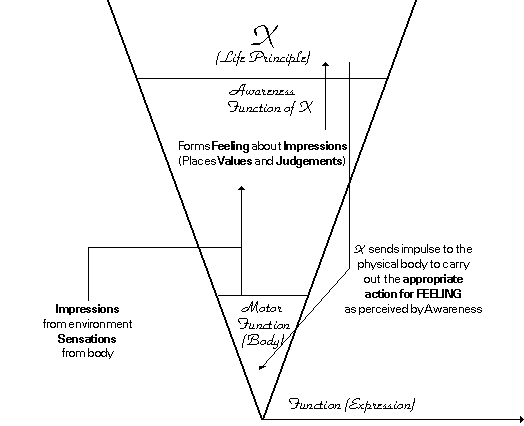 Figure 2 -- Picture of Integrated Man
By looking at this picture again, we can see it the way we did earlier -- when we described the psychology and functioning of a child (regardless of age) -- or in the simple way that it is shown here, in Figure 2.
First force, X, has set up a remarkable means of self-expression.
The motor function (physical body) receives impressions of the environment and physical form; which are put into a symbolic image as perceived by X's Awareness function (mind).
The Awareness function compares this image to the purpose for living, and places appropriate value on what is being experienced in the environment and body, generating a feeling for feedback to the Awareness and X.
X then, through the motor function, balances the whole to the environment as perceived by the Awareness function, by bringing about the appropriate internal function, and outward action, and behavior.
Thus, the entire picture can be seen as a means for this incredible Being, X, to express Self as an individual -- Spirit manifesting in a material or physical form.
And each focus for an individual Awareness function can have its own purpose, at least in a developed, actualized, human being.
Each lives in their own environment or world, which is like no other world on planet Earth, since no one else may share that particular purpose or that particular perspective on the environment determined by individuality.
Regardless of purpose, each sees from a unique vantage point that is like no other, because there is only one being who stands at this particular focus that the I or Awareness function always occupies.
Thus, we must wonder just what the individuality or Awareness function is.
This incredible being, X, is extremely creative: that much is obvious.
All we need to do to see just how creative, is to look around at the myriad expressions of the Life Principle on planet Earth.
Each Awareness function is one of the vast number of talents of this remarkably creative and talented being -- of the whole -- X.
That individual Talent is then given expression in a physical form.
That Talent or Awareness function is given the illusion of separation from the whole by the senses of the body which perceive as though the entire universe radiates out from self.
This gives that individual Talent the ability to express self completely as an individual, while being supported by the vast Intelligence of the whole -- which keeps everything in balance to the environment perceived by that individual Awareness and which brings about all action.
In most of us, this is going on unconsciously: that is, we have no ongoing awareness of the relationship between ourselves, the functioning of the body, and the vital principle, X, that keeps it all working and in balance to the environment.
We are completely deluded by this illusion of separateness into believing that we are separate.
But a few decide that this unconscious playing out of the expression of Talent is not what they want to do with the great gift of Life (conscious though it seems to those who have never experienced anything close to full Awareness).
And they begin questioning the way things seem, and discover that information has been provided by a higher Intelligence because that is the aim of that higher Intelligence: to create via evolution (growth and development), a form that can Consciously contain the tremendous force of X's vitality and express knowingly and Consciously: with Awareness.
One who Lives with that force with just a little Consciousness of it knows just how powerful it is.
It is as though a thin wire were to suddenly have thousands of volts of electricity running through it.
The wire would simply be destroyed at its weakest point -- where there is the most resistance -- by the energy of the electricity: it just can't handle the power.
But one who uses these ideas that have been provided by a Loving Intelligence to allow for our further Conscious evolution -- by taking each of them and working with them: using them to see with as one goes about one's daily living, while looking for contradictions -- finds oneself transformed by them.
That is the use for these ideas: to allow for the completion of the evolution of the physical and spiritual bodies and the Awareness from the inside out this time -- instead of solely from forces acting on it from the outside (survival of the fittest) -- by activating something that lies dormant in most of mankind.
And soon one finds that the body can begin to experience a greater measure of the fullness of Consciousness of Awareness and X playing and Being together -- and can act in the outer world as an individual expression of Higher Intelligence.
Perhaps one day the personality will be transformed, and will stop seeing itself as the only thing there is in the body, and become the servant of the Awareness rather than the other way around; and the Awareness will be experienced enough to allow that creative Being, X, to fully express Himself through the vehicle of a serene, loving, mind and body.
For almost all, the individual Awareness of self is not lost in this conscious interplay between X and His Awareness function.
Rather it is heightened: one becomes more oneself; more aware of one's unique abilities -- because they are developing from potential into realized expression.
And we have been promised that one who plays this role in full Awareness is developed into a new kind of Being and Life that Lives forever.

One of the interesting things that we can observe about these four Ways of Living is that each has an inner and outer expression.
The outer expression is for the entire race: and is provided for the development of mankind as a whole.
It is a Way for Living that (hopefully) everyone will begin to use.
When that Way of Living is used by many then it changes the Way that mankind perceives Living.
In considering this, we might see that the aim of evolution is to create mankind as a race of Conscious expressions of Universal Intelligence, and that the means have been provided for each individual of the race to follow the evolutionary path designed for the whole of mankind: which is the only way that it can be accomplished, one by one.
So each Way of Living also has an inner expression -- an inner Way of Living, and ideas that can be used to develop each person who uses them from the inside, for their own personal growth and development -- to be able to Live in the Way that is there for the whole race; individually, one by one.
The Ways of Survival and Justice had their inner evolutionary paths to follow that would develop the potential for each individual to become a realized human being as well as one who could truly Live by those Ways in the outer world.
We can still see the remnants of the inner Ways of Survival and Justice.
But they no longer lead to a full realization of a person's potential -- those Ways have been closed off in the inner, spiritual, world.
That doesn't stop people from continuing to follow the ``way of the warrior'' or the ``way of the shaman'' and other such nonsense still left over from the Way of Survival, though -- very few have any idea where all this is going, so how would they know whether it still goes there or not?
When the Way of Justice was discussed, it was pointed out that a small set of rules had been given that would lead to an inner feeling or recognition that one needed somehow to grow and develop the ability to follow those rules -- that one wasn't already able to live by those rules.
And those who acted on that inner feeling of necessity found the ideas that we are discussing that describe what is necessary for the realization of one's full potential.
These two Ways also had an outer Way of Living that was about creating a social organization to express these Ways.
When man lives by the Way of Survival, small groups are formed that are what we call tribal in structure.
Often those living by this Way declare every other group as outcast -- or not fully human -- to justify treating them as a threat to the survival of ``our'' group -- which has been formed to make the survival of those in the ``in'' group possible in what is perceived as a dangerous, threatening world of ``others'' -- who are also trying to Survive.
The Way of Justice allowed for much larger groupings of people, and allowed these tribes to build great permanent places for living.
Again, these larger groupings of people created rules that made their way of life possible, and then found themselves in conflict with others who lived by slightly different rules, even though both sets of rules were designed to accomplish the same purpose.
Then things tend to drop back to the level of Survival -- but this time for people living in cities or nations grouped by differing ideologies -- rather than for the Survival of the race as a whole.
The Way of Understanding had both an inner and outer path for personal development, and for the development of mankind as a whole or as a society, also.
We can easily see the remnants of the outer, sociological, path: because there are still groups around that only know about the outer and claim that is all there is.
The original groups that were formed to bring about the Way of Understanding in the outer world taught a new type of behavior that everyone was to follow in that outer world, as a social Way of Living.
Those who used this Way were basically to see everyone and everything with Consideration for the whole, and to act with Charity (both are aspects of some of the many, many aspects of Love) and to live in constant faith and prayer (another aspect of Love and Understanding) -- but without bringing a lot of attention on oneself because one is living that Way.
This third Way of Living socially, had we tried it, might have allowed mankind to find a way for the large groupings of people called nations that were formed from living by the Way of Justice to coexist in harmony -- rather than dropping back to the level of Survival when their differing ideologies clash.
The inner Way of Living for one using the Way of Love was very different from the first two Ways, yet it also involved realizing (much as was described with the Way of Justice) that one could not be constantly Considerate and Charitable and Understanding in all that one does without some incredible change taking place in one's inner Life.
When this was seen, an individual was given ideas about another Way of Living that led to an inner transformation that allowed Love to be their inner and outer experience all the time.
So, again we see this interesting way of bringing about a new kind of human being by using evolution.
A Way for Living is provided to mankind, that can be used in the entirety of experience: both as a Way for interacting with our outer world and environment; and as a Way for Living in the inner world that brings about a transformation in the person them self; an inner evolution that makes the outer Way of Life possible as an inner reality or perception rather than as an imposed set of ideas or rules from society and authority and officials.
When we speak of a transformation -- or a dramatic change in lifestyle -- one way is to say that something has died and been replaced.
So, much of the language of the Way of Understanding is about the death of the old person and the birth of a new kind of person: one who can constantly Live a Life of Love or Understanding.
This inner path for the development of Understanding is not so well known these days, because it was eventually corrupted by those who claimed godhood for the teacher of the Way -- and who claimed that one didn't need to actually follow that inner Way of Living -- one only needed to believe completely in the godhood of the teacher of that inner Way and all would be wonderful.
These inner and outer Ways are just as present in the fourth Way of Conscious expression of Universal Intelligence.
There is an outer path that is about building a new world for Conscious beings to live in -- the world as it is set up now is not very conducive to Living Consciously -- and a new inner Way of Living that is to see all whom one meets as an expression of that same Universal Intelligence except that most are living as that Universal Intelligence unconsciously.
Again, one who attempts to do this finds that they cannot see this Way all the time without a very dramatic change in their inner Life -- thus bringing about the necessity to find the ideas that lead to inner transformation.
This is not an idea to look at and attempt to use just in one's inner Life.
It is a practical Way of Living in all aspects of one's Life.
It is now the job of mankind to build a new man-made world -- not the utopia where all will be happy in their unconscious obedience to rules which we are currently working to bring about -- rather a world where each individual is a Conscious Intelligent being at work and play in the man-made world.
It was mentioned in an earlier section of this chapter that the man-made world consists of ideas and ideals, standards, machines (technology and tools), and games.
Most of the games that we are playing today are not making it easy for everyone to see the need for Conscious living.
About the only contribution they make to this end is: that one who really considers the games people play can see no real point to them -- and that person may then look for the ideas that can be used to develop their individual potential through an inner transformation.
We are being asked to find new games to play in the outer world -- in our social living -- that would be enjoyable and reasonable for players who are Living Consciously as expressions of Universal Intelligence in the outer world -- and to discard the old games that are no longer appropriate for our current stage of evolution.
Almost every one of the games that we play now in society is about obstructing two of the more necessary and valuable aspects of living that a Conscious being can experience and express: responsibility and cooperation.
Those who choose to continue working with X to bring about the fourth stage of mankind's evolution will begin to create new games (or modify existing games) so that they are based on responsibility and cooperation; rather than playing games based on irresponsibility and competition.
The old games will simply fall away from disuse and lack of interest, without any effort made to remove them.
And those who give up on the idea of competition will find themselves a part of something that already exists: a small group of individuals who have their own -- unknown to those who compete -- society based on cooperation instead of competition.
The inner path of the fourth Way is one of the most efficient ever found to bring about the inner transformation that makes this possible, because it is based on conscious participation with an incredible Intelligence beyond our understanding and knowing.
It can accomplish in a few years what usually took half a lifetime in the Way of Understanding, and pretty much an entire lifetime for most people in the Way of Justice or Survival.
This makes it possible for us to have the time to experience an inner transformation and Live a Life of Conscious Intelligence and still make a contribution to the outer evolution of all mankind, even within our considerably shortened lifespans.
I hope that you can get a sense of what this new Way for us to Live is, and even better that you can see the necessity for some of us to evolve to a higher Way of Living as Conscious expressions of Intelligence.
This new Way is called Conscious, because each of us are to begin to be Consciously Aware of all that is going on: both inside and outside of us.
The ideas that can teach us -- that are a clear, objective, description of ourselves and our world -- are here.
If we use these ideas to re-educate ourselves, we grow in the ability to be Conscious of everything that is going on, all the time.
This new Way is called Intelligent, because the Conscious Awareness allows the free action of Universal Intelligence in Living without active resistance from the Awareness.
By actualizing the Awareness as a Conscious reporter about this unique, individual being that is I -- and the field of living and environment being experienced by the individual I -- then X can respond to the circumstances of self and environment with all the Intelligent creativity that the Creator can bring to this moment.
The inner motive force of this new stage of evolution is gratitude.
By seeing that there is a Loving Being Who is, and always has been, present in our Lives -- Who is always providing whatever we need to further our evolution -- we can begin to see that all the second force that we resented so much is actually a great gift that allows us to grow and develop our potential -- or the point at which we will destroy ourselves while we live unconsciously with that great power: X.
So one begins to appreciate Life, and to feel grateful for this opportunity, and that becomes the inner feeling that colors and motivates all that one perceives in this new Way of Living.
This results in an entirely new kind of being; one who is reveling in the interplay of X and Awareness in experiencing Life.
To begin, one makes a new decision about living -- that one wants more than anything else to be realized; so one can Live fully and be able to work with X and contribute to mankind's evolution.
This decision allows us to create a new function in the Awareness: the ability to observe all that is going on in the mind, and the impressions that are coming from the environment -- all that one is aware of -- without getting caught up in whatever suggestion it is making to the mind at this moment.
When one is paying attention to all that is being observed, everything is then held up to the light of this new decision; and seen as a contradiction to what one really wants.
This allows that one to make an entirely new aim for one's life: to Live Life Consciously, in the fullest Awareness one can bring to each moment.
One realizes that one is still in thrall to the old purpose of living that demands ever greater pleasures and escape from all pain.
This new decision allows one to create a new direction to travel that is somewhat contradictory to that old purpose: it serves in place of a new purpose until the Awareness has grown and developed enough to create a new purpose for one's Life based on Conscious Understanding and the expression of Higher Intelligence.
All that has been observed with attention is compared -- not just to the old purpose -- but especially to this new decision for the new aim of one's living: to be realized.
Since one still has the old purpose for one's life, it is understood that the value is still on gaining pleasure and avoiding and escaping pain: even though a new value, a new good, has been seen.
So one gives each contradictory observation to the power of X to deal with, because one cannot deal with it from one's own power no matter how hard one tries.
In this manner one begins to use the ideas given for our growth, and experiences gratitude to the second force or resistance to the old purpose; and begins to re-educate themselves into a new kind of Living that is Conscious and expresses Intelligence and gratitude for being allowed this wonderful opportunity to experience Life Consciously.
| Experiment -- Gratitude |
|
Spend a couple of weeks looking at all the second force in your daily living.
|
Questions to Consider:
Can you see that each experience of second force offered you the opportunity to see something about yourself or living that would have allowed you to grow into greater Understanding (Love) and Awareness (Consciousness) -- had you felt grateful for the experience?
Could each experience of second force have been seen as an opportunity for you to turn to your Creator, X, for the creativity required to use that moment of second force to accomplish your true aims for your life -- instead of an opportunity to struggle against it and make everything you work for as hard as possible?
Would seeing this allow you to learn to be grateful for living, and to your Creator for having offered you the greatest gifts of all: Life; and the ideas you require to understand and use that Living to develop the ability to ever more fully express your unique, individual, Talent -- which is like no other in existence -- in conscious experiencing of the relationship of X and His Awareness function?
|
There is a very famous movie making the rounds again as this is being written.
It's called ``It's a Wonderful Life'' if memory serves.
People get very sentimental about this film once a year or so.
In case you haven't seen it twenty times yet: a man -- George Bailey -- is born in a small, boring, town.
His father owns and runs a small savings and loan, which never makes very much money because his father has such a big heart that he's always giving the profits back to the townspeople one way or another.
George decides that he's going to leave when he's old enough and make something of himself -- he wants to become a great architect and build impressive buildings all over the whole world -- that, he believes, is what will make him feel good about living.
But circumstances conspire to keep him from his dream and he ends up owning and running the same savings and loan, in the same way that his father did before him.
About the only thing he ever builds is some small, inexpensive, houses for the poor in the town to own so they can buy a home instead of renting from the greedy bad guy who owns the bank and the rest of the town.
But his dream of traveling and doing something important with his life never leaves him: so he is miserable just about all the time, because he can never act on his big ideal.
And he manages to make sure that everyone else knows it, because, after all, they are the ones who trapped him here.
Even though the entire town loves him, his wife loves him, his children love him and I'm sure the local mice love him for something or other.
Finally, circumstances end up with someone who works for the savings and loan losing a lot of money at the same time that there is a bank auditor reviewing the books (the greedy bad guy who owns everything finds the money and keeps it, of course).
George is about to be bankrupted and arrested: generally ruined; or so the George Bailey Awareness tells X.
So he runs off to a bar, gets drunk, prays for the first time in his life for help, crashes his car, and decides to end his life rather than face what he is certain will be the outcome of this situation: after all, his life hasn't been much fun so far, and this is just too much too bear on top of every other failure to live up to his ideals.
An angel trying to move up in the heavenly hierarchy is sent to ``help'' him.
The angel does this by magically showing George what the world would have been like had Mr. George Bailey never lived: and boy is it a mess -- everyone in the town is in a sorry state, indeed.
George has a change of heart, and decides to face and outlast his troubles.
Of course, in the meantime, his wife has found out about the problem from the person who actually lost the money, and she has told everyone in town.
Just about everyone in the entire town George ever helped floods in and offers a few dollars each.
The savings and loan -- and George -- are saved.
I guess from this we're supposed to learn that every life has its contribution -- as long as you live it with a good and giving heart.
So I guess this movie is supposed to reassure us with a new idea: even though you believe that your life is worthless, that you have never managed to do anything important enough with it; as long as you lived it with a good and giving heart then it will be seen one day as the greatest contribution there could be.
I heard another odd little statement the other day: that the most common occurrence in all reported near death experiences is folks being asked two questions before they come back to life (who does the asking I didn't hear):
-
What did you do to grow in love while you were living?
-
What contribution did you make while you were living?
But let's look at George's life from his point of view and see how he lived.
George never allowed the misery of his life to push him into questioning the purpose of his living -- which he believed was to be big and important and well-known and a great builder (designing and building big buildings was the contribution he wanted to make so he would look important).
So being important was the real purpose for his life, wasn't it?
If I do one thing to get something else, then my real purpose was the latter -- what I actually wanted to get from the first thing -- wasn't it?
What I did to get it was the means for getting my real purpose, not the purpose itself.
So George spent years making contributions unconsciously -- not as his purpose of living -- just because of the type of person he was: because of the way his individual Talent cast his impressions of living into perception.
He never spent any time learning about that individual Talent that was his Awareness function.
The Talent expressed, of course, because at every circumstance that Talent for caring for others reported its individual take on the environment, along with everything else the personality had to say about what was going on.
And X acted on it appropriately. But the Talent expressed without his conscious intent.
And at the same time, his personality -- which wanted the pleasure of doing great things and being thought important for these great actions -- reported to the Awareness that his life was shit: because he still wasn't doing great and important things yet and probably never would.
So his life was one of more or less constant misery, with occasional good feelings.
And the Awareness told X about that, too, because it was in his environment, just as much as all the facts about the outer world were in his environment.
And X acted on that appropriately, so he spent a lot of time making others miserable as he pined for a life that he was unable to get for himself, because those others kept needing him and trapping him in his current life; and the Awareness couldn't just ignore their needs as the personality kept telling him to do.
So the personality kept making up excuses so he could act on his individual Talent, but only as seen through the misery of his personality.
So he made another contribution, didn't he, that was not emphasized in the movie: he made those closest to him miserable.
They loved him, but he wasn't happy, and he spent a lot of time letting them know how he felt about them trapping him in such a worthless, small, life: hoping they would eventually take the hint and stop trapping him there with their love and needs.
Two contributions, both made without any Love, Understanding, or Consciousness:
-
A contribution to the misery of everyone around him because they need him.
His individual perspective based on his Talent couldn't let him ignore their need.
But neither could his personality ever let him forget the pleasure of building and feeling important -- that he was completely missing out on because his individual Talent wanted to love and understand and couldn't because his personality wanted pleasure and -- what a vicious circle;
-
A contribution to a few people being more able to make their lives better by contributions of cash, and just about everyone in the town having little extra things to make their lives a bit more comfortable -- things that someone else in the town was working very hard to take from them and keep for himself.
Bailey's individual personality saw this and reported it to the Talent which reported it to X and X acted on it as part of the environment.
Neither of these two did he do with any awareness.
Of course, in the movie, a catastrophic event occurred that allowed him to reevaluate a bit, and he felt pretty good about the contribution to comfort that was made -- and may have even reconsidered and repented the other contribution to misery, and decided instead that he felt grateful for the opportunities that had been given to one who was unconscious throughout their life to grow and develop -- even if those opportunities had never been used and acted on.
And the townspeople certainly gave him a large dose of feeling important, didn't they?
Even though he only built small homes for them instead of grand buildings all over the world.
Let's look at this in a technical sense, and ask a simple question: Who's doing what?
We see an Awareness with very little understanding for self and others more or less continually reporting two conflicting facts about the environment, and the outcome.
The personality was designed, like ours is, to take as much pleasure from living and avoid as much pain as possible.
-
The Awareness kept seeing that the outer world needed him where he was, making small contributions to the comfort of others -- and the personality could take pleasure in the feeling of importance that gave him occasionally, so it agreed with that view of the environment;
-
The Awareness kept feeling that it must make a big, grand, contribution to life -- and the personality wanted the pleasure that would bring and said it would accomplish both by traveling and building all over the world -- both together reported an inner feeling of misery at being trapped where that desire could not be acted upon as far as the personality could see.
-
X did what was appropriate.
X acted upon the perception of the outer world by making small contributions to the rest of the townspeople's lives through George Bailey's Awareness of what was going on.
X acted upon the perception of the inner world by making the misery known to Bailey -- and everyone else around him -- in action, so Bailey could look at it and resolve the conflict of his life: which he never chose to do until a catastrophic event entered into his life as a great gift from X.
And X acted upon all of this by building many small homes that contributed to Bailey's acquired desire to build and the townspeople's need to own homes for themselves.
Now this is all fiction, so it is not a completely accurate picture -- having been filtered through the non-technical yet artistic awareness of the writer.
But it does illustrate unconscious living pretty clearly if we take the time to look at the story technically instead of through the ideals and desires of the personality -- because it has been simplified by the artist.
We're supposed to get a warm feeling about living in general, and our lives in particular.
We probably have ideals for ourselves and others that we and they are not living up to.
If so that is bringing us great misery as well.
Many of us, of course, believe that we have done so much that we don't feel this at all, and think this analysis is irrelevant to their living.
But perhaps each of our lives is as good as George Bailey's, if only we could see it -- or so the author of the movie seems to be telling us.
But I notice that, even with the prayer for the first time to his idea of God, and the intervention of an inept angel of mercy, George never reevaluated the way that his Awareness was working.
He never noticed that he didn't need this big catastrophe to see the constant presence of X in his Life.
He didn't decide to make his living conscious, and understand this personality that had spent so much time making a mockery of his Life with its ideals for self and others.
So the fact is, he was living unconsciously.
What he called a conscious life was a life of conflicting urges to power and importance and to growing in love and understanding.
And conflicting urges to make grand contributions that would allow him to feel powerful and important and the feeling that the actual contributions he was making were small and worthless and insignificant -- not good enough to allow him to feel important for making them, except occasionally.
And X made sense out of all these conflicting urges, and turned the life into one of contribution in spite of the point of view of the Awareness function.
So I ask again, Who's doing what?
Perhaps we feel reassured by some of the ideas in this book.
Perhaps we see that each of us has a part to play in the creation of mankind.
But we might feel that just knowing about this is not enough.
We want to know the part that we are playing -- and we are certain that it must be something wonderful.
And this little movie seems to offer us that reassurance, without the dreaded effort of actually becoming consciously aware of our living and the role Awareness and X play in that Life.
But let us reconsider Universal Law and the four forces of creation: perhaps there are a few who have already Consciously joined with X in the creation of mankind.
They are initiating (first force) with Him, with full Awareness of what they are doing.
There must be second force (resistance) for a form (third force) and result (fourth force) to come about, mustn't there?
So it may be that most of us, being unconscious of this glorious act of creation going on all around us, are playing a very necessary role: that of second force to those who have joined with X Consciously in the creation of mankind.
X is making His contribution to that ongoing evolution and creation, even on His day off.
And some have chosen to Consciously participate by Living a Life of Love and Understanding and Conscious expression of Universal Law and Intelligence with an inner feeling of gratitude or serenity for the marvelous opportunity to be part of the creation.
And almost all the rest of of us are providing second force to those few and to X.
Humanity is being given what is needed to begin to live on planet Earth Consciously -- in gratitude and serenity -- and to build a world based on expressing Intelligence in all that we do.
We are to begin to build a world that is designed to provide for the possibility for everyone to live Consciously.
And, of course, we will be doing so while realizing that there will be some who will not wish to join this effort, so that must be all right with us -- there is no point in arguing with them -- there is just a job to be done.
Some will continue to live by the Ways of Survival and Justice, and very infrequently Love or Understanding: we're busy building another world for conscious and intelligent beings to live in.
What would this look like in our individual lives?
Well, first, let's take a look at the world that we have now.
Mankind has worked very hard to make a world where very few (if any) would ever need to accept any responsibility.
There is always something or someone to blame for our problems.
The doctor blames the lawyers and business; the government blames business and theology; the businessman blames lawyers and government; the lawyer blames doctors and business; the psychologist blames theologies; the minister blames doctors and government; everyone blames everyone else, but no one is responsible.
And the layman or non-professional blames them all.
How in hell did we get into this predicament?
By not wanting to be responsible for our own lives.
We decided to try an experiment that no doubt seemed very exciting at the time.
We demanded that a group of professionals do our job for us.
We figured that if some people were able to take their pleasure from discovering and inquiring and finding out about self and the world, then we could spend our entire lives on the pursuit of what pleased us.
And the professionals would discover how to give us the freedom to do so.
So we formed several groups of professionals, and charged them with the task of discovering how to create a world where we could all be free from fear.
And we left this task to them (which is really the responsibility of each of us to do for self) while we went after what we believed to be the real purpose of living: pursuing happiness.
The professionals would work on freedom: they would discover how we could live so as to be free from the fear of illness; free from the fear of violence; free from the fear of old-age; free from the fear of ignorance; free from the fear of want; free from the fear of money problems and lack: the list of fears goes on and on.
And fear actually has many forms, that we do not consider to be fear because we have given them different names: hatred, bitterness, resentment, anger, guilt, nostalgia, shame, insecurity, inferiority, helplessness, apathy, depression, disease, infirmity: all the ills that ``plague'' mankind -- including the ``hope'' that it will all get better, somehow.
And while we were pursuing happiness, the professionals would periodically report back to we laymen as to their progress.
The non-professionals' job would be to build a mind that could accept the fruits of these professionals' labors, incorporate what has been learned into our ways of pursuing happiness; and then we would all be one step closer to the illusive bluebird of happiness which always flies just a little ahead of us along the path of our lives.
Can any of us say that this has worked?
Have we accomplished even one of these objectives?
Are we free from the fear of illness and old-age?
Or have we simply poured trillions {CHECK THIS} of dollars into an incredibly expensive system of treatment and research so that we can now be even more afraid of an ever expanding list of illnesses -- more than our grandfathers and grandmothers even knew existed, much less worried about?
Are we still pouring billions of dollars every year into the attempt to fight disease -- as though disease were an army of evil entities that we must wage a war against in order to one day vanquish them so that we can finally be free from the fear of disease and infirmity?
How many more trillions of dollars will it take (and remember that each dollar represents the sacrifice of someone's time and effort and living) before we realize that we cannot fight off illness and old-age as if they were an enemy army -- before we realize that the only way to be free is to be responsible for our own lifestyle -- that we will not find freedom by paying someone else to search out the enemy and destroy it for us.
Are we free from the fear of lack and want?
Or have we simply set up a new group of professionals who are to provide us with something to do, and products to buy with the pittance that we are given for doing what they provide?
So a few decide that in order for them to get the good life they must live in a world of consumers.
These professionals -- who become the greatest consumers of all -- produce a few things for others to consume while being paid a little something to labor in their world of consumption -- which they call producing.
How many more billions of dollars will be poured into the game of consuming until we realize that happiness does not come from the outside, from our possessions?
Before we realize that joy is something that is put into all that we do, not something that we take from living by finding the right thing to do that would make me happy?
That consuming all there is on the planet will provide us with nothing more than a few more moments of distraction: not a life of joy or gratitude or love or even peace of mind (serenity).
So we let the professional entrepreneurs tell us what to do -- what to produce for others to consume -- so that we, too, will be able to consume enough that we will no longer need to fear lack and want and emptiness.
Yet fear of lack and want and emptiness are still rampant in the world around us: when do we admit to ourselves that no matter how much we consume, we will not find freedom from fear?
Are we free from the fear of powerlessness and the fear of lack of purpose and the fear of pain and suffering?
There are so many fears that drive us to theology: the fear of being alone; the fear of having no real purpose to our lives; the fear that comes from being in the unknown without understanding; the fear of our future; the fear that comes from suffering without understanding; and many more.
And we do all have some urge within us to find ourselves.
And some of us cannot ignore the urge to find a greater power within ourselves, greater than the only one that we know: will power -- which turns out to be almost no power at all.
So we go to the professional theologians and ask them to tell us what to do about these fears.
And we have built great buildings to house our fears; places where we can go to be told what to do, and what to think -- and that if we just believed hard enough then we would be safe in some unspecified future.
This world actually has four different kinds of teachers: and how many of the ones who teach in these great places of worship teach responsibility for self -- which could end our fears?
Responsibility ends fear -- it does not simply relieve it temporarily -- it ends fear and conflict -- yet when have we ever been told that it is possible to end fear and conflict?
Do the theologians (and their more recent counterparts, the psychologists) actually teach that man is a victim of something, thus perpetuating our fears, not ending them as promised?
And does each have its own idea of what is victimizing man: a tempting devil; a tormenting god; childhood traumas; a false self that must be cleansed or sent by some form of special thought/non-thought into nonexistence or some other outer darkness?
Do these professional theologians teach us that we cannot be responsible?
(No matter how much they talk about responsibility, if there is something that is victimizing us, or something to blame according to their ideas, then we are not responsible -- the victimizer is.)
Are we told that we must depend on these professionals, because they -- and they alone -- know the safe path through the perils of living on planet Earth?
Then who is responsible, when one depends on another?
If you really want to be afraid, consider what happens when one who is not responsible depends on another who is not responsible.
These professionals do teach us that man must accept an ideal to live by as a standard and method for controlling the horrible dark side, or the terrible tempter that wants to destroy us -- or whatever is to blame, that is victimizing us.
And the ideal is all right -- it should be accepted -- because it comes direct from god or beingness or some other such authoritative nonsense (such as a statistical norm that allows us to function within the ideals of our society).
And if you can just manage to control yourself, and become whatever ideal your particular theology preaches, then you will be rewarded later: it's always later, no matter what the theology, for almost all of us -- all but a special few.
How many more people will spend their lifetimes practicing some method that will finally improve them to match the ideal given by their gods, hoping for a future where all the pain and suffering they are experiencing now will be gone, or at least make sense?
Hoping for a time when they will be free from fear?
Yet these theologians do not provide us with a way to experience living with that unknown part of each of us that is Life itself -- a Way of Living which might provide us with real understanding so that we could make sense out of the suffering that is part of life here.
They just talk about it, and some even tell us that only special people, the consecrated priests, can even approach the awfulness of that Being (or those with extensive and expensive training which we must repay for them, since they did it for us, not for themselves).
How long will we listen to these devil teachers tell us that we cannot be responsible, that we can only practice some method of self-control by ideals, before we realize that our pain and suffering is of our own doing by misunderstanding our purpose on planet Earth?
It is not something that has been done to us, the poor helpless victims: thus our fears are groundless when we are responsible.
Are we free from the fear of violence and ignorance?
How many more trillions of dollars are we going to pour into our legal systems and hand over to our governments before we admit that they cannot provide us with freedom -- that it is responsibility that makes freedom possible, not safety from the outside, purchased with force?
When do we admit that the method that we have chosen -- to pay off those who frighten us (the poor, the outlaws, the lazy, the ignorant, the crippled whether physically or mentally or emotionally) -- has only led to greater violence?
And why shouldn't it?
We have said that they are to blame for our problems, and perhaps if we pay them enough, they will go away and leave us alone.
How would you feel if someone said that to you?
Would you feel on the wrong end of being tolerated and condescended towards?
Would you feel a bit violent towards the person with their hand out, who is waging a war against poverty and bigotry and crime and drugs -- and you are the enemy?
And then we have to create more rules, to stop the violence due in part to our unwillingness to be responsible and accept an obligation towards the poor and the crippled.
So now we are seeing that the welfare state becomes violent and makes necessary a police state.
So what do we do?
Do we say enough already, and accept responsibility for charity, instead of believing that it can be institutionalized?
Or do we continue demanding that the professionals -- the lawyers and law makers and authorities and officials and experts -- do something about it?
Can we say that any of these fears of ours have been ameliorated by this institutionalized irresponsibility -- that they are gone, or even close to gone, and no longer need to be feared?
Or is it time that we realized that there is no method, no way to live, that will make it possible for us to give away responsibility -- that freedom is something that each must experience by inner responsibility, and express for themselves outwardly -- that even duty (when accepted) must be accomplished by each one who will be responsible for their own obligations.
These cannot be hired or contracted out, no matter how many trillions of dollars we spend trying.
Or, to be brief: are we simply being personally irresponsible and paying through the nose to do absolutely nothing but make matters ever more fearful?
It is about time to accept that this system has not worked -- that this experiment has failed.
We cannot pay someone else to be responsible for us.
No amount of human sacrifice of time and effort will appease the great gods of our inner world: greed and fear and all their children.
Many will not see this, and there is absolutely nothing we can do about that for them -- each must be responsible for themselves.
The professionals have done nothing more than shirked the same responsibility that we ourselves don't want -- and tried to pay them to do for us -- the responsibility for understanding self and our world -- to grow up and stop looking for someone else who will be grown-up enough to take care of us so that we could remain children safely and forever.
These professions have done an excellent job with some things.
I would never want to belittle what has been accomplished.
But neither will I pretend that it is as much as has been claimed -- nor that we are on a path that will lead anywhere that anyone in their right mind would want to go.
So it remains, as always, to those few who are willing to question absolutely everything, even the purpose of living -- even the idea that life is all about achieving happiness (whatever that means) -- everything.
These few have always been amongst us, and one or more occasionally feels that there is such a great need that one is willing to publicly discuss what has been learned from a proper education of questioning, regardless of the consequences for self, personally.
And these few have always said that we must be responsible for our growth and development ourselves: that there are those who will serve as guides, but they cannot do it for us, they can only show the way.
We can learn that we can only be responsible for ourselves.
That is the only way that anything can be done.
It may be occasionally possible to hire out obligations and duties, if we are willing to supervise and be responsible for the results.
But responsibility is an inside job: no one can be responsible for me but me.
So here we are back again with the question: what would this look like in our individual lives?
Each of us can learn about living for ourselves.
Each of us can learn about Universal Law and accomplish what the healing arts professionals have not: freedom.
We can learn about our inner life and its relationship with Universal Law and Intelligence and accomplish what the legal and governing professionals have not: freedom.
We can learn that I am a part of the Creator, Universal Intelligence, X, the great unknown, and accomplish what the theologians have not: freedom.
We can learn about the consequences of not seeing Universal Law and the greed to always have more, better and different so that we will one day be happy and accomplish what the big business professionals have not: freedom.
It starts with each individual who is willing to properly educate themselves by trying everything out for themselves instead of relying on someone else to do it for them.
We can apply what we learn, and some of us can begin to build another way of living that relies on individual responsibility rather than socialized irresponsibility and create a world that fosters the growth and development of Conscious Intelligence in all men and women.
The world that we have built so far actually fosters unconscious ignorance.
In this world the path of least resistance is the one that leads to not seeing that we are responsible, all of the time, in every moment and situation.
It does not ask, it demands at gun point, that we pay through the nose to allow a small elite to do our thinking and to do our duties for us -- while our job is to choose between the rock and the hard place that these great thinkers come up with -- anything but be responsible; because they can not be responsible for us.
They are not even being responsible themselves, any more than we are.
Here in the U.S. we have a belief that the answer to most problems is education.
Yet we have continually demonstrated that education does not solve our problems.
When we first considered the possible outcome of A.I.D.S., we decided to see if educating people would stop the spread venereally.
And -- what a surprise -- it did not.
So we said, what the hell, and used brainwashing instead.
We threw out education and made up a small list of easy to remember rules and scared people into believing them and called it education.
But even this was too much for people to pay attention to and remember, so eventually we just threw up our hands and said, ``No sex without protection.''
And still we called it educating.
Could it be that we do not know how to educate?
So it may be that this theory of educating has never really been tried.
The word educate is actually derived from a word that means to draw forth from inside.
Yet all our attempts at education are actually about training (applying from the outside until it becomes unconscious prescribed behavior), not about a method for allowing a person to find out for themselves (offering something from the outside that allows each person to develop understanding on the inside by trying to disprove what is given, which then expresses itself as outward action).
Let's see what happens if those who are interested begin to educate themselves properly, guided by the few who have already tried it.
A proper education relies on the individual to make up their own minds: without dogma, without ideals, without right or wrong.
It simply says: here is a description that no one has ever been able to disprove.
Check it out for yourself: try to prove it wrong.
Then do what seems proper to you with what you have found out, because there are no conclusions offered as to what to do; just how to find out for yourself and build an inquiring mind.
Even what is offered here is just a description of what mankind has built, and some ideas about what may really be going on.
There is a suggestion that those who are interested do something about it.
What?
That is not my place to say, so I have not said.
Should we abolish the professions that we said haven't worked if we find out for ourselves that this is true?
Why?
Some of what they have accomplished is very valuable.
There will be many who will not accept this great opportunity: responsibility and freedom.
Many may continue to need these professions until there are enough who are responsible for self, and who are free to live and express creatively without them (or maybe in a new form that does not attempt to take away, and claim that it is possible to relieve one of, personal responsibility).
Will those who are responsible be willing to pay for (offer sacrifices for) this continuing irresponsibility?
Possibly not, except at gun point.
Let those who will not be responsible for themselves pay for their own ignorance.
Perhaps like minded groups of responsible individuals will form (after we have enough responsible people with self-understanding) and try out various ideas.
Some of these ideas may turn out to be very successful (workable) -- so others will start using them as they prove themselves in actual social living.
Eventually we may, together, find a way to build a world based on responsibility for self and freedom of expression and creativity.
A world that is responsible for continuing the efforts to build a place where all people can live as Conscious expressions of Universal Intelligence in harmony with all.
Ways will be found, not because someone told us what to do and how to do it, but because many expressions of Intelligence find it an interesting challenge and will work together to get the job done.
Is this just a ridiculous pipe dream?
Perhaps it is.
But consider for a moment how the folks who lived entirely by the Way of Survival must have felt when someone came along and said to them, ``Now we're to live by rules and Justice.''
They would have said, ``Yes, but: if I only act with enough force to temporarily stop that other violent person, they will just come back and do it again some other day.
What will I have accomplished?
It's not enough for just a few of us to do this if everyone else is living by Survival.''
But they did it anyway, and kept on working at it.
And I'm sure that for a while they had to do a lot more killing than they would have liked, because this was a valid objection.
But now, thousands of years later, we see that it has become a workable, if not perfect, system.
We are no longer dealing with providing second force to Survival: violence is no longer necessary nor desirable.
Someone recently told me that the ideas given for the Way of Love are completely unworkable as a Way of daily living.
I replied that I use them every day in my business.
Then they said something to the effect that we cannot just go around forgiving our debts and turning the other cheek all the time.
But in the business, if someone cannot pay a debt, I do not take them to court.
I know that most people do pay their debts.
Those who can, but will not, I do not want as customers.
I simply want to cut my losses from my own lack of judgment, and move on and work for people who appreciate what I do enough to pay for it.
And those who can not pay for some reason I do not want to hurt any more than they have already harmed them self by getting into that position.
So, again, I simply wish to move on and work for those who value what I do and can pay for it.
If there are not enough who value what I do and can pay for it, I am in the wrong business: what value would there be in forcing them to pay their debts?
Rather than spend time and effort forcing people to pay their debts, I would prefer to put that time and effort into making money by working.
And the result is that I have rarely had the problem of unpaid debts.
And when I have, it doesn't matter: I'm too busy making more money to worry about a few unpaid debts.
We could use the same argument quoted above as being against Justice to show that Love and Understanding will never work.
And many people have, haven't they?
Imagine if our ancestors had been swayed by this argument against ever starting to use the Way of Justice?
Would humanity even exist today?
Can we see that this argument, along with some others mentioned earlier, did stop most us from even trying the Way of Love or Understanding?
And yet it works for those who use it, even in a world still living by the Ways of Survival and Justice.
We could just start this new task, and let the rest of the world follow along or not as they wish -- and then there would be no problem -- except for the pioneers, perhaps; and occasional throwbacks here and there.
Any time we start something new it is easy to say that there will be interesting and possibly unpleasant situations with those who do not move along with us.
Or we can just start and see what happens -- and deal with the necessary second force or resistance that is always lovingly provided when we start anything new -- and keep initiating anyway and see what form develops.
| Experiment -- Games |
Spend a few days looking for the games that you and others play.
A game is anything that has:
-
Players;
-
Rules;
-
Rewards for playing by the rules, and penalties for not using the rules;
-
Officials to make sure the rules are observed (who are often the players themselves).
Examples are: the traffic game; the business game; the relationship game; the war game; the friend game; the roommate game; the lonely game; the victim game; the know-it-all game.
|
Questions to Consider:
What is rewarded in each of these games?
Do you enjoy playing games where the rules are unknown, or change all the time at the whim of one or more of the players?
Is it possible to play a game without competition?
Without a winner and a loser?
How many of the games that are played are designed to encourage the growth and development of Conscious Awareness, and expression of Universal Intelligence and Creativity?
|
 Table of Contents
 Chapter 3
Chapter 7
 Copyright © 1996 by inX.
 Finished January 10, 1996.
 Science of Man's Conscious Self-Evolution
 View from the Real World